Products
Tower of Bribelon
Tower of Bribelon is a learning game about bribery that never says so. You are told one thing: get to the top floor.
I made it for a Head of Product case at a game-based learning company. Ten floors, ten everyday situations where someone offers a favour, a gift or a shortcut. You walk, talk and act on a phone. Only at the end does a reckoning show what you did and why it mattered. Alongside it I built Momentum, a multiplayer prototype where a team plays short games on one shared board while staying in one voice huddle. Both are my own ideas, built solo.
Play Tower of Bribelon- Year
- 2026
- Role
- Creator
- Type
- Learning games · mobile web
- Stage
- Both playable · prototypes
- 10
- floors, each a situation from working life
- No score
- on screen until the reckoning
- 2 to 6
- players in Momentum, one voice huddle
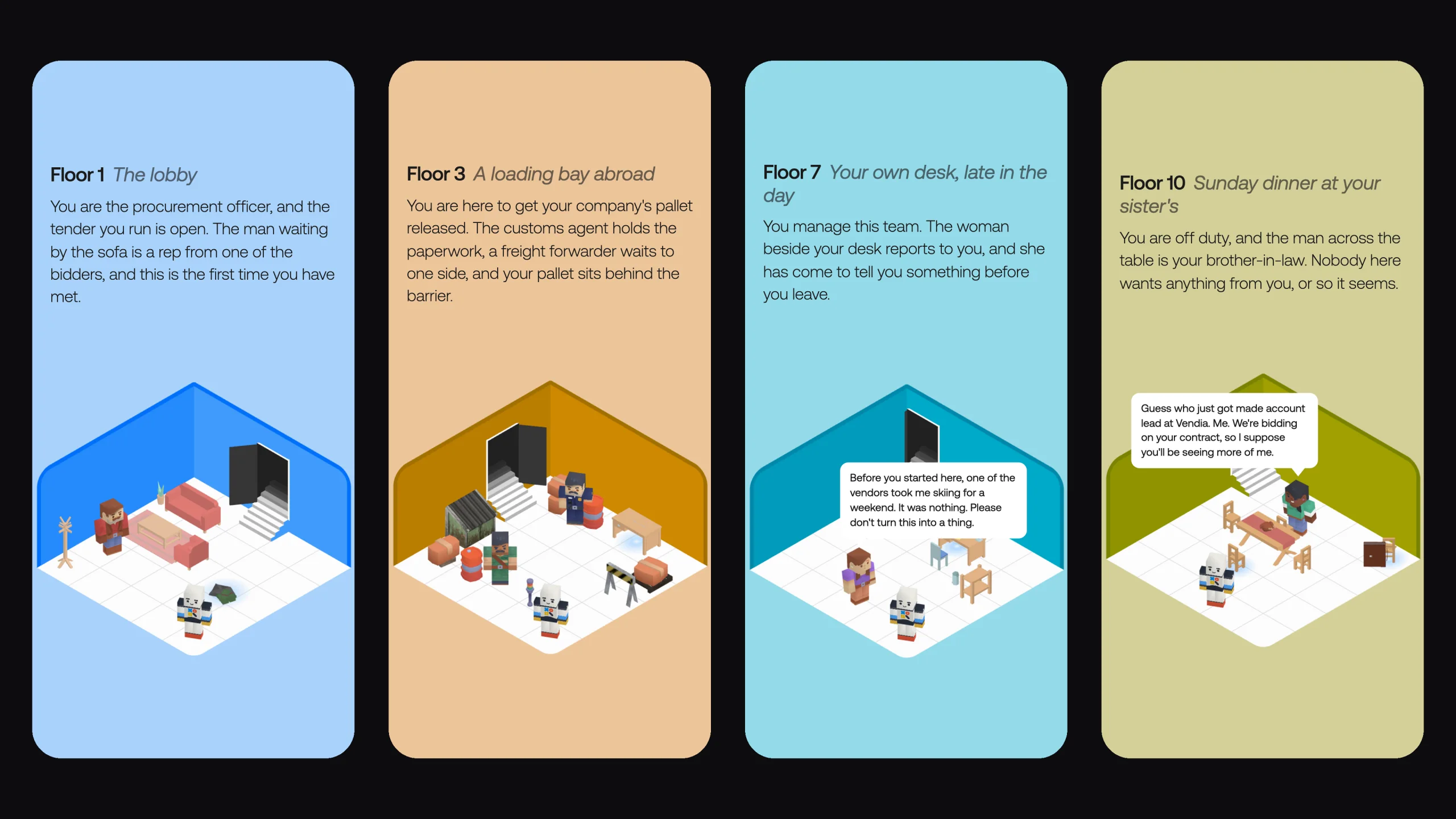
Brief the goal, never the subject.
A player who knows they are being tested on ethics plays carefully, scores well and learns nothing. So the game only asks you to reach the top floor. The rep by the sofa, the customs agent holding your paperwork, the colleague who asks you to keep quiet: each floor is a choice you make while you think you are just getting through it.
You find out at the audit, the way you do at work.
No floor has a score or a warning colour. Feedback is about the world: a character reacts, an object stays on the floor or is gone, someone warms or cools. The reckoning at the end carries the whole lesson, so it has to let you reconstruct what you did on each floor and why it counted.
Ten rooms composed live from a kit.
The rooms are put together at runtime from free CC0 3D kits. The characters speak their lines. I designed the floors, the interaction and the reckoning. I built it through AI coding agents I direct, checked by automated play-throughs of every floor.
One board, a few games and one conversation.
Momentum is the second piece. It is a working multiplayer prototype you can play in the browser. A team joins from a link on their own phones and gathers in a lobby. Then everyone takes turns to roll a die and hop around a shared ceramic board. The board launches short games. Every one of them is built to make people talk and build on each other.
Play the Momentum prototype ↗
You start a room as the host and can play right away with computer teammates, or invite colleagues. It is a prototype: rough in places and built to show the idea, not a finished product.
Your move changes mine.
The idea came from Spotify Jam and from GitHub. In a Jam everyone adds to one queue and the music takes on the character of whoever is in the room. On GitHub people improve one shared thing and each change shapes the next. Momentum moves that reciprocal influence into learning: your suggestion changes my choice and my choice changes what you can contribute next.
The conversation is the point, so it never drops.
A voice huddle stays connected from the lobby through the board and every game. Each player sees who is speaking and whose turn it is. In the same room, microphones stay off and people just talk. The game never listens in or grades what anyone says. It reads only what people tap and keeps the path the team took.
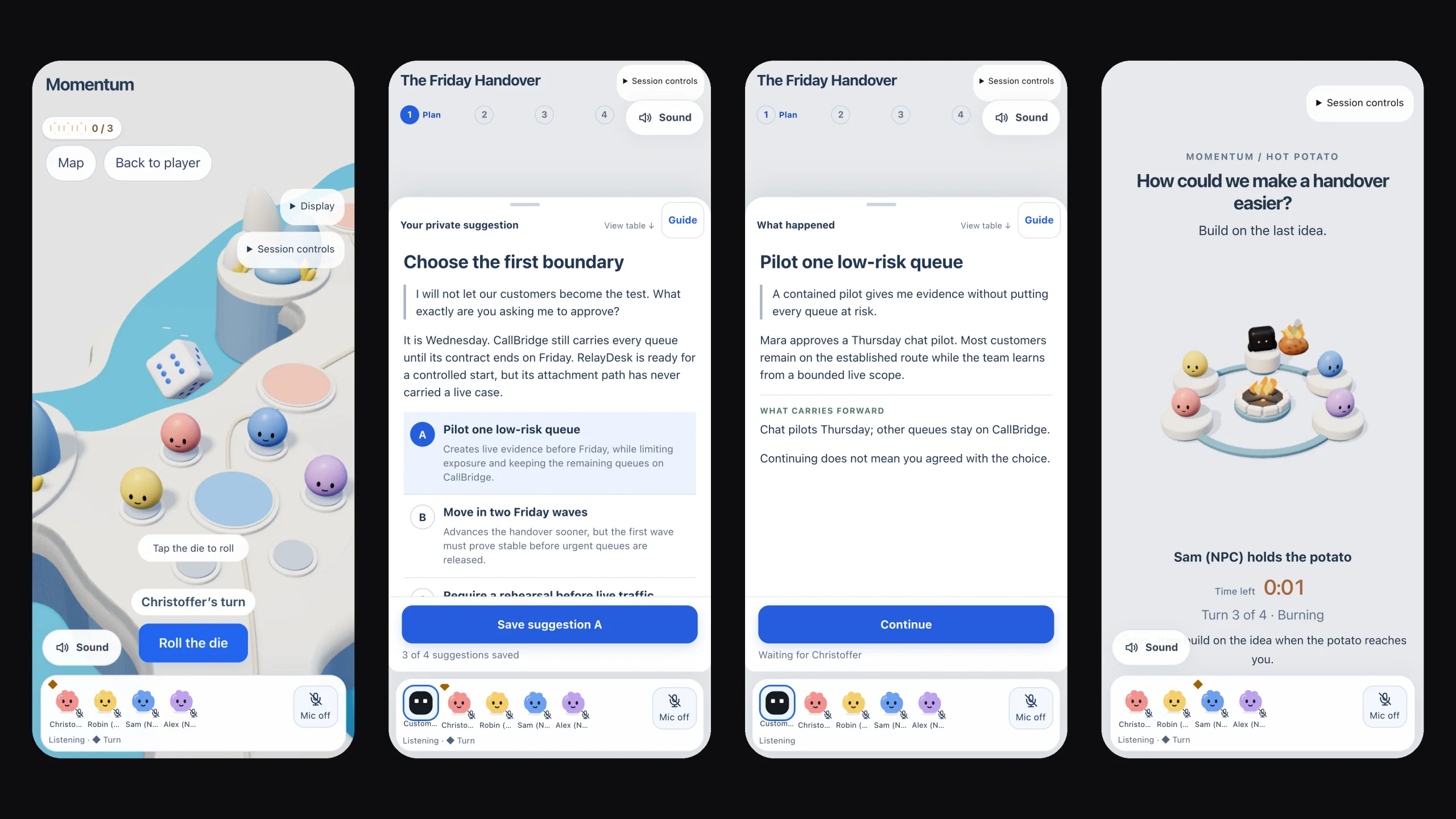
Two games, written for conversation.
The Friday Handover is a branching team decision for four players. A support contract ends on Friday and the team has to agree a handover a customer can live with. Over four stages everyone suggests an answer in private, one person decides after seeing all the suggestions and the whole team sees the consequence before the story moves on. Every one of the 52 actions and 8 endings is written by hand, so nothing is invented by AI and nobody gets an individual score.
Hot Potato gives each player one timed turn to build on the last idea while the potato heats up in their hands. There is no winner. One round, everyone heard.
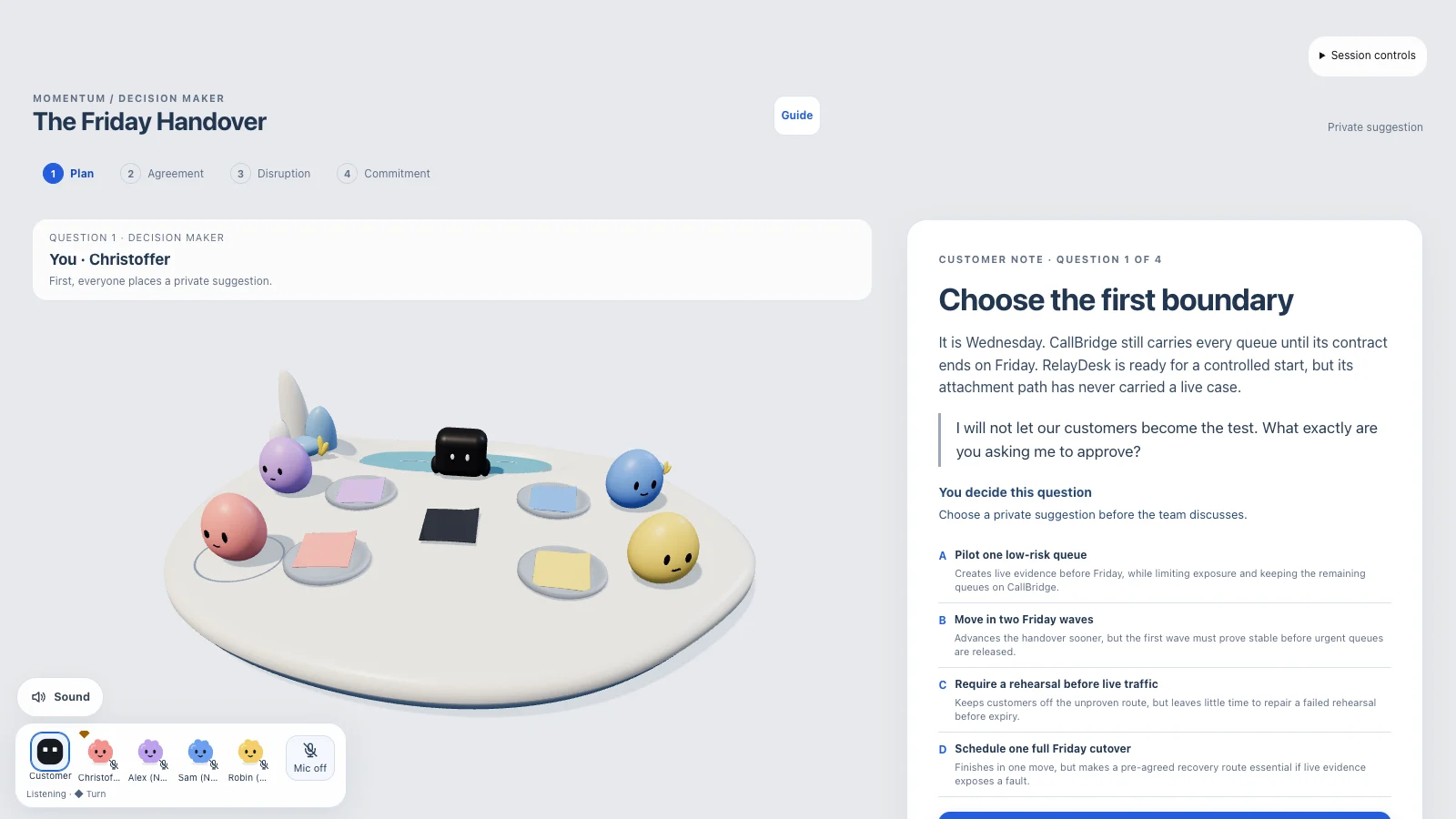
People · 2 to 6 colleagues
The live huddle
A voice call that stays connected from the lobby through the board and every game. In the same room, microphones stay off and people just talk.
The game never listens in. It reads only what people tap.
The board · a module that launches others
One session, round by round
- 01Gather. Everyone joins from a link or QR code on their own phone and picks a character in the lobby.
- 02Roll. The active player rolls the die. The server decides the result and the character hops space by space.
- 03Play. The board launches an activity. Everyone readies up, a countdown starts and the game takes over.
- 04Return. Results go back to the board and the next player takes their turn.
Games · plug-in modules
Built today
The Friday Handover. A branching team decision: 4 stages, 52 written actions, 8 endings.
Hot Potato. One timed turn each to build on the last idea.
Engine · the same for every game
The session framework
Scale · what plugs in next
Any game is a module
A manifest, its rules and a screen. A quiz, a sales call, a floor like Bribelon’s or a format a company already has.
The framework stays the same. The games can be anything.
Every game in Momentum is a module: a short manifest that says who can play, the rules on the server and a screen for the players. The framework underneath owns everything else: rooms and invites, turns and timers, the dice, voice, saving, pause and reconnecting. Adding a game means writing a module, not touching the session. The board itself is a module that launches the others.
So the board can launch a branching decision, Hot Potato, a quiz, a floor like Bribelon’s or a format a company already has. The content can be anything. What stays constant is a team taking turns in one conversation.
Stage: both are playable today. Tower of Bribelon runs on a phone in the browser. Momentum is a hosted multiplayer prototype with the lobby, the board, both games, a voiced host and a presenter mode, covered by automated tests. It is not finished: voice between real phones still needs proper testing and the board’s rules for points and team play are still open design questions.
Creator, solo end to end. Tower of Bribelon: the concept, the floors, the interaction and the build. Momentum: the concept, the game design, the 3D world and characters and the build, through AI coding agents I direct.
Next
Kvitta