Ventures
Oyster AI
I'm co-founder and CPO of an AI platform that runs a solutions architect's job end to end. I own the product experience and write the shipped code, which our CTO clears before it ships.
Oyster turns an IT reseller's raw case (stand up a data center for this client, on this vendor, at this scale) into a generated architecture and as many validated configurations as the deal needs, then into the client-ready collateral that closes it. It's grounded in real vendor catalogs and article specs, not a chatbot. What takes a senior, single-vendor solutions architect twenty minutes to six hours by hand, Oyster gets roughly 95 to 98 percent of the way in minutes, by my own internal measure; the specialist verifies and signs off. Three founders. Strategy is shared. I own everything the user touches, from the design to the shipped code our CTO clears. Live today, with users across Europe and a pilot underway among solutions specialists at a major vendor.
Visit Oyster- Year
- 2025–present
- Role
- CPO & Co-founder
- Type
- Agentic platform · IT procurement
- Stage
- Live · users across Europe
- Minutes
- to do what takes a senior architect 20 minutes to 6 hours by hand
- ~95–98%
- of a configuration served before a specialist verifies and signs off, internal measure
- Live
- with users across Europe and a pilot among solutions specialists at a major vendor
Solutions architecture is done by hand, by specialists who each know one vendor.
A reseller’s solutions architects turn a client’s requirements into a defended architecture, a set of vendor configurations and the collateral that wins the deal. By hand that’s twenty minutes to six hours per configuration. Only someone deep in that one vendor can do it well. The expertise is siloed and the throughput is capped. We started Oyster open, for anyone configuring their own procurement. We learned the market doesn’t want to self-serve; it wants to be a customer, with someone to turn to. So we built for the resellers themselves. We hold the licenses to sell across the major enterprise vendors. The strategy is narrow then wide: take one vendor to near-perfect, then expand vendor by vendor and team by team.
A case in, the deck out, grounded in real vendor data, not a chatbot.
There are two versions of Oyster on this page. The one we have just rolled out is for a single solutions architect working alone. It starts with one vendor. The earlier one is for a firm with a team of architects, organised around shared cases. Both run on the same engine.
In the solo version you describe the requirement in plain words: the workload, the scale, the vendor. The agent asks for what is missing, then builds the specification against real vendor catalogs and article numbers. From that one specification Oyster draws the architecture and a 3D view of the installation, rack by rack. A finished configuration exports in the vendor’s own file formats.
The team version opens on a case: the client, the vendor, the scale. Oyster generates a case overview, then an architecture, then as many configurations as the deal needs. From there the team compares configurations, asks which one fits a given use and generates the sales material: presentations, one-pagers, PDFs. Case to client-ready in minutes, with direct API hand-off to the vendor’s platform on the roadmap.
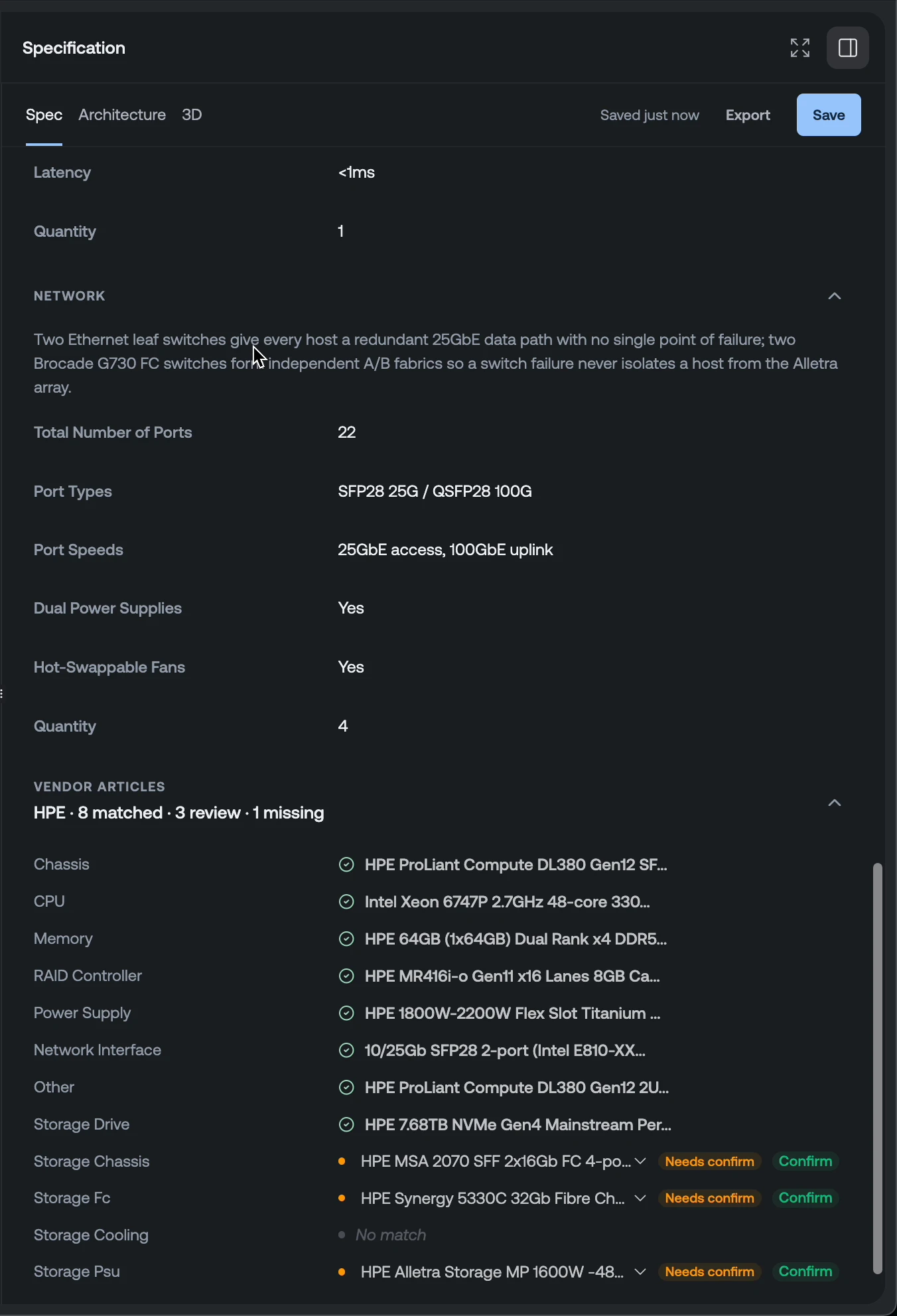
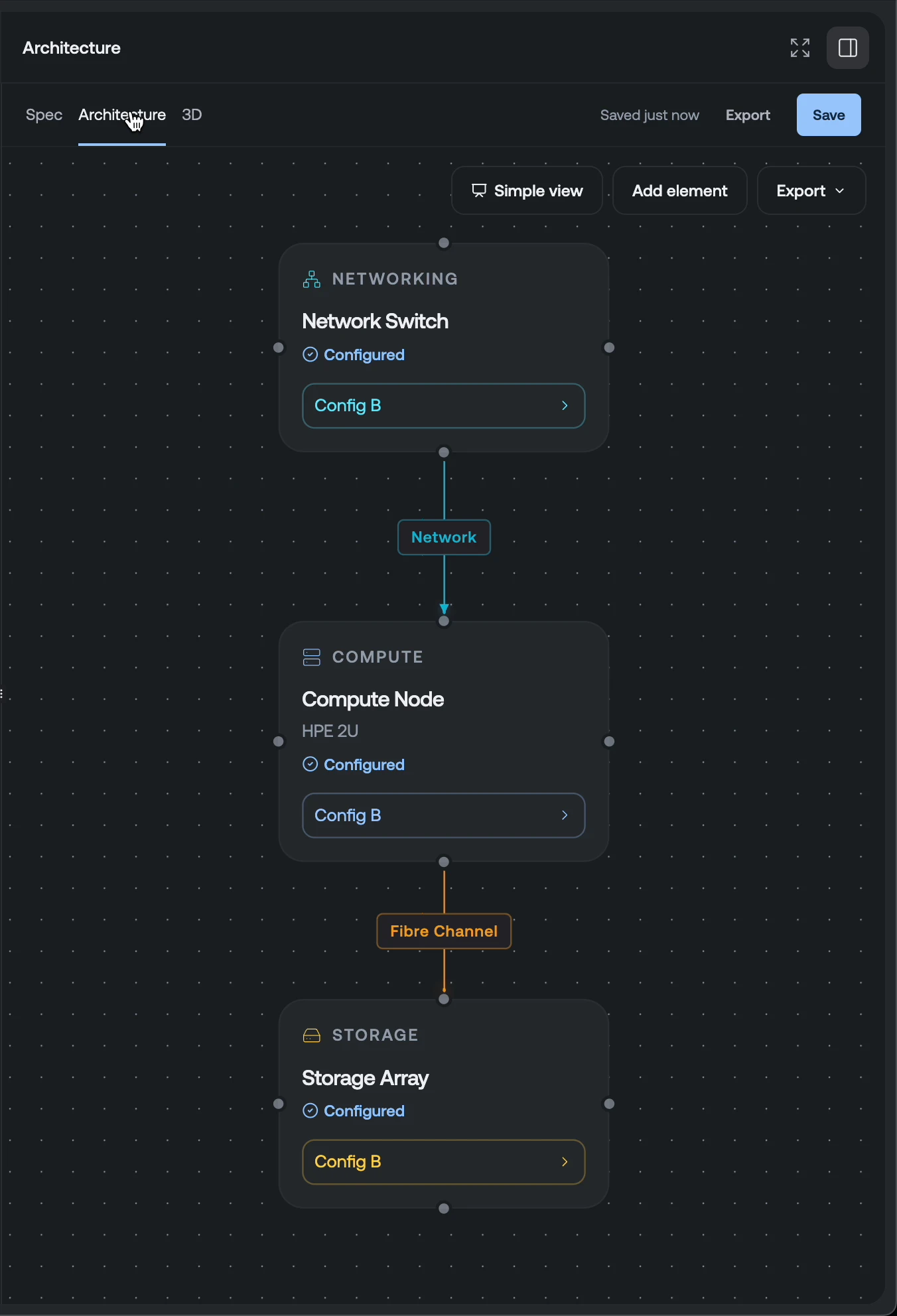
I own everything the user touches, from design to the shipped code.
Across the three of us, the product experience is mine: every flow, the branding, the look and feel, plus the value features themselves (the comparison views, the document and deck generation), built from design through to the shipped code, which our CTO clears before it ships. My thesis is an adoption thesis. Advanced capability only gets used if it feels frictionless and premium; get one small thing wrong and that friction is what the user remembers, not the value underneath. Making something genuinely advanced feel simple and balanced is the work. I’ve taken cohesive responsibility for it since day one.
The solo version’s interface runs on its own tokens, with six palettes and light or dark chosen separately. Each pane folds away, down to the conversation alone. It is a second design system beside the one the generated documents are built from. One serves the person working. The other serves the client reading the result.
The build I'm proudest of: generation that stays consistent and never drifts.
Document and artifact generation. Every output is editable by AI or by hand. The HTML artifacts (decks, one-pagers, dashboards) are surgically editable: select a piece, describe the change, the system makes it. Under it sits a system I built of themeable primitives: real components, styled per theme and filled with each case’s data, so generation is composed, not improvised. It saves a great deal of token cost every run and, more importantly, it doesn’t drift: you get what you expect, every time. The same discipline runs through the engine we built as a trio: cost-aware and tuned against an accuracy harness.
An LLM hands you surface-level work. A product takes more than asking nicely.
The lesson under all of it: order an LLM to build something and you get a confident, surface-level answer, because models are people-pleasers. A real product means breaking each feature into six-to-eight smaller, self-evaluating deliveries, each held to a Grade-A bar, close to perfect and passing its tests, before it counts as done. I also built a design language the team and the AI build against, so the output stays composed and consistent. The point is getting AI from “this could work” to something you’d put in front of a client. I now carry the method into every project.
Stage: live, with users across Europe and a pilot running among solutions specialists at a major vendor to harden it on real cases. The honest accuracy line, roughly 95–98% of a configuration served before a human verifies and signs off, is our own internal measure, not an independent benchmark. It’s reported that way on purpose. The proof here is the working system and the pilot, not revenue: we chose to bootstrap past the pivot and raise on proof rather than dilute at zero.
CPO & co-founder, one of three. I co-originated the concept and the business plan with our CEO. Strategy is the trio’s. I own the client-facing product, from the design to the shipped code our CTO clears; we built the engine together, with my co-founders leading the vendor-article validation loops. Honest stage: live with users across Europe, plus a pilot at a major vendor.
Next
Heywire